Every few weeks, a client sends us Facebook ads written by ChatGPT and asks us to just run them.
No edits. No strategy. Just “AI wrote it, can you launch it?”
I get it. I really do. AI is remarkable, and when it does something well once, it’s tempting to trust it completely from that point forward. That’s human nature. But in the supplement space, in healthcare, in any regulated industry where the FTC is watching and your competitors are actively looking for reasons to report you, that kind of blind trust is one of the fastest ways to blow up a business you’ve spent years building.
So let me be honest with you about what I see happening out there, and what we do differently at Social Impressions.
The problem isn’t AI. It’s the gap between a prompt and expertise.
When someone sits down and types “write me five Facebook ads for my supplement brand” into ChatGPT, they get five Facebook ads. They might even look pretty good on the surface. Compelling headlines. Decent copy. But here’s what’s missing: fifteen years of direct response marketing experience isn’t in that prompt. Compliance considerations aren’t in that prompt. The psychology of why a customer actually pulls out their credit card isn’t in that prompt.
When I use AI, which I do every single day, the instructions I’m giving it are shaped by everything I’ve learned across hundreds of campaigns. My experience is essentially baked into how I ask the questions. That’s a completely different output than what you get from a generic prompt, and the difference shows up immediately when someone who knows what they’re looking at reviews the work.
Where the real risk lives for supplement brands.
The most dangerous territory is any public-facing content that makes claims, even indirectly, about what your product does. AI doesn’t know the difference between a claim that’s legally supportable and one that will get you an FTC letter. It doesn’t know your specific formulation. It doesn’t know what your particular ingredients can and cannot be advertised as doing. It just generates confident, convincing language, and confident convincing language about supplement ingredients can constitute a medical claim whether you intended it that way or not.
We’re now at a point where AI tools can post content on your behalf automatically, on a schedule, without you touching it. That capability is genuinely exciting and we use versions of it ourselves. But a human has to be in that loop, reviewing what’s going out, making sure nothing crossed a line while you were sleeping. The “set it and forget it” fantasy is exactly that, a fantasy, and in a regulated space it’s a dangerous one.
Here’s the thing most brands genuinely don’t understand about the FTC.
Most people assume the FTC is this distant government agency that goes after big corporations. What they don’t account for is that your competitors are watching your social media too. As you grow, the brands you’re competing with have a real financial incentive to report you for violations. And when the FTC comes in and audits your social media history, they’re looking at everything you’ve ever said publicly, across every platform, in every ad. One problematic claim buried in a post from eight months ago counts.
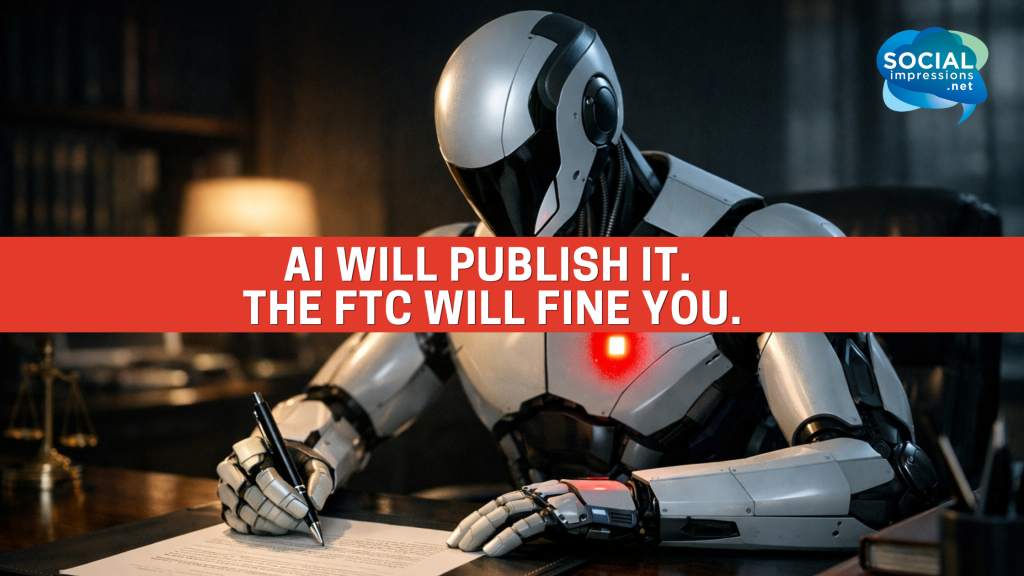
According to the FTC, the maximum civil penalty is $53,088 per violation as of 2025, adjusted annually for inflation, and each individual post or ad can be counted as a separate violation. In January 2025 alone, the founders of one supplement-adjacent company were ordered to pay over $5 million. The math gets scary fast when AI is publishing content on a schedule and nobody is checking it.
And the fact that a social network approved your ad does not mean the ad is compliant with the law. Facebook approving your ad means Facebook approved your ad. That’s it. The FTC operates independently of what any platform decides to let through.
The flip side: the possibilities genuinely are endless.
I don’t want this to read like a scare piece, because the honest truth is that AI has transformed what we’re able to do for our clients. Brainstorming content, researching influencers, drafting outreach, building campaign frameworks, even generating AI influencer videos, we’re producing more, faster, and at a higher quality than we could have just a few years ago. That’s real and it’s exciting.
But even when we’re generating AI influencer content, there’s a human reviewing those videos before anything goes live. Always. No exceptions. The human-first step isn’t optional overhead, it’s what makes the whole thing work safely.
If you’re a supplement brand owner reading this, here’s what I want you to walk away with.
The potential AI gives your brand right now is real. A small operation can produce content at a scale that would have required a much larger team even three years ago. But the risk scales with the capability. More content means more chances for something to slip through that shouldn’t. That’s why you need to be working with people who understand your industry, not just people who understand the tools.
If something sounds too good to be true, it almost always is. There are a lot of people right now selling the idea that you can type a prompt and AI will go out and sell a million bottles of supplements. That’s not where we are, and honestly, it’s probably not where we’re ever going to be. The hype is real. The shortcut isn’t.
AI is a genuinely powerful member of our team. It’s just not the one making the final call.
If you’re navigating social media marketing in a regulated space and want to talk through what responsible AI-assisted campaigns actually look like, reach out here. Happy to have that conversation.